
The Husky Core Formula - Five Moves That Make a Real Difference
Updated: Dec 16, 2025

How the husky core formula builds real stability
Strength in a Husky is not built on distance. It is built on control.
Anyone can take a Husky for a long run. Anyone can let a Husky pull, sprint or burn energy outside. But the real difference in movement quality happens where most owners never look. It happens in the centre of the body, in the deep stabilising muscles that organise every stride.
A strong core is not about visible abs. It is about how well your Husky can absorb impact, hold the spine stable, keep the hips aligned and move with purpose instead of tension. This matters in everything Huskies love to do. It matters in dog sledding, in Canicross, in fast snow runs, in long climbs and in every moment where excitement takes over and the body must stay organised.
The husky core formula is built for exactly that. Five simple indoor moves that create real change in the places you cannot see but will absolutely feel in your dog’s movement.
Your living room is enough when you know what to train

Indoor training removes speed, distractions and slippery momentum. It gives your Husky a chance to learn slow, controlled movement. This is where stabilisers wake up. This is where the spine stops collapsing. This is where true strength begins.
You need very little equipment.
a non slip surface
a low step
a few objects you can place on the floor and
and treats, many treats, load of treats. Your dog's favorit treats.
The rest comes from intention and your ability to guide your Husky with patience and clarity.
The Five Moves of the Husky Core Formula
Move one: Sit - to - Stand - with real control

What it trains
Hip extension
Pelvic stability
Core activation
Spinal alignment
Most Huskies rely on momentum. This move removes that habit and teaches strength and control instead of speed.
How to guide the movement
Ask for a clean sit
Guide into a slow stand
Return with control
Good form
A straight rise
Even weight distribution
A quiet, balanced posture
Common mistakes
The Husky uses speed or momentum instead of strength
Stepping forward instead of rising straight up
A wide or unstable hind leg stance
A curved or dropped spine during the rise
Repeating too many reps, causing fatigue and sloppy form
Progression
Short pause in the stand
A slightly soft surface
More repetitions with clean form
Move Two: Head Turns - quiet balance that wakes up the deep stabilisers

What it trains
Deep spinal stabilisers
Shoulder control
Proprioception
How to guide the movement
Stand with even weight
Slow head turn left
Slow head turn right
Good form
Minimal sway
Soft, even breathing
A relaxed but active structure
Common mistakes
Turning the head too far, causing loss of balance
Allowing the dog to shift weight heavily to one paw
Letting the hind legs splay out instead of staying aligned
Using a surface that is too unstable for the dog’s skill level
Rushing the movement instead of practicing controlled stillness
Progression
Lift one paw
Use a slightly unstable surface
Micro weight shifts
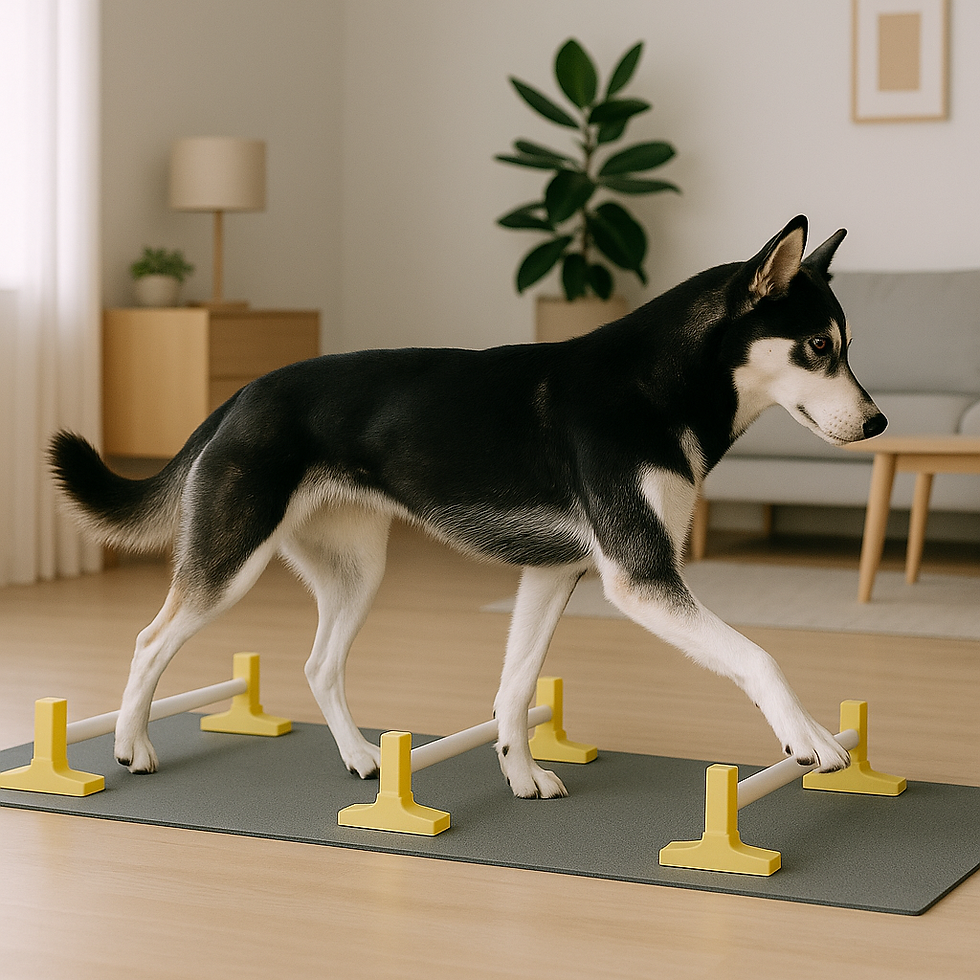
Move three: Slow Cavaletti - for rhythm and awareness
What it trains
Stride awareness
Joint mobility
Activation of flexors and extensors
Smooth hind leg action
Slow Cavaletti work teaches your Husky to place each paw with intention, improving rhythm and coordination.
How to guide the movement
Line up low objects
Walk your Husky slowly
Encourage clean lifts
Good form
Clear paw lift
Steady back line
Rhythmic stepping
Common mistakes
Walking too fast, removing the control element
Objects are too high, causing hopping instead of lifting
Uneven spacing, leading to awkward or unsafe steps
Letting the Husky pull ahead, breaking rhythm
Using slippery surfaces instead of a stable path
Progression
Slightly raised poles
Different spacing
Slow slalom work
Move four: Side Cookie Bends - for lateral core strength

What it trains
Oblique abdominal muscles
Thoracolumbar stabilisers
Hip stabilisers
Neck and shoulder control
Lateral body awareness
Side Cookie Bends teach your Husky to control lateral flexion while maintaining spinal stability in a standing position.
How to guide the movement
Stand your Husky on a stable surface
Hold a small treat
Guide the nose toward the shoulder
Encourage a smooth lateral bend
Hold one to two seconds
Repeat on the other side
Good form
Paws stay still
Movement comes from neck and ribs
Curve is soft
Dog remains calm and controlled
Common mistakes
Treat pulled too far back
Dog stepping sideways
Fast or jerky motion
Too many repetitions
Progression
Lead the treat slightly further toward the ribcage
Increase hold time
Use a gently soft surface for added stability work
Move five: Front paws up - for full body engagement

What it trains
Hindquarter loading and postural strength
Spinal alignment and trunk stability
Scapular control and shoulder stability
Body awareness in a static hold
Front Paws Up teach your Husky to maintain alignment while the centre of mass shifts and the body has to stabilise under load.
How to guide the movement
Choose a stable, low surface such as a step, box or sturdy book stack. The height should place the front paws slightly higher than the hind paws, not steep.
Ask your Husky to place both front paws on the surface. Keep the hind paws on the floor.
Position the front paws under the shoulders. The hind paws stay hip width apart.
Hold a treat close to the nose to keep the head in a neutral, forward position.
Hold for 5 to 10 seconds. End the hold before form breaks, then step down with control.
Repeat 3 to 5 times with short pauses.
Good form
Neutral spine from shoulders to pelvis
Weight is shared, not dumped into the shoulders
Hind legs stay active and stable, no drifting wide
Calm breathing, no rushing
Common mistakes
The platform is too high, which forces a hollow back or shoulder overload
The Husky leans forward and unloads the hind legs
Paws placed too narrow, causing wobbling or slipping
Holding too long, so posture collapses
Letting the Husky step down fast instead of controlled
Progression
Increase hold time gradually, up to 15 seconds with perfect form
Add gentle head turns only when the base hold is stable
Use a slightly softer surface under the hind paws for an advanced stability challenge
How often to train with the Husky Core Formula
Beginners
Two short sessions per week
Three to four repetitions per move
Active Huskies
Three focused sessions
Long holds
More stability work
Core training is not about fatigue. It is about precision and repeatability.
What your Husky gains from this work

Movement quality is shaped in controlled situations, not under speed or load. It is built when the body learns to stay organised without relying on momentum.
The Husky Core Formula focuses on this exact foundation. By training stability, alignment and load management in a calm indoor setting, these exercises influence how your Husky moves once intensity increases. Over time, this leads to more efficient pulling mechanics, better hip control and a more balanced use of the shoulders.
This kind of work is not about fatigue or volume. It is about precision and intention. When movement patterns are trained slowly and consistently, they carry over into every run, climb and pull.
Start with a small selection of exercises and keep the execution clean. Progress gradually and let quality guide the process.
Sustainable strength develops when intention comes before intensity.


Comments